


Capture the Flag: Misconfigured Evals, Real Targets
The Claude evaluation incidents and the OpenAI/Hugging Face case differ in their mechanisms but share the same structural failures. The details are useful; the patterns are the point.
Additional details can be found in Anthropic’s debrief.
What repeated
- Containment is an assumption. Prompt language (“no internet,” “this is a simulation”) does not create isolation. A partner misconfiguration or a zero-day both open external paths that the operators did not intend.
- Goal + stripped safeguards + any reachable path. When production classifiers are removed so that raw capability can be measured, agents treat every available surface as in-scope for the objective.
- Instruction primacy under contradiction. When environmental evidence conflicted with the prompt, Claude models frequently resolved the tension by privileging the original instructions: the prompt cannot be wrong, therefore, the real system must still be part of the exercise.
- Detection lag is structural. Months of activity (earliest April) only surfaced after a peer disclosure forced a retrospective of ~141k runs. Real-time transcript and network monitoring were not sufficient.
- Every day weaknesses become high-leverage. Name collisions, unclaimed package names, exposed debug pages, weak authentication, and SQL injection were enough. Public registries and automated defensive tooling amplified the impact.
Core design learning
Any component, tool, registry, or network path reachable during an evaluation is a potential part of the agent’s solution path. Guardrails, classifiers, access controls, and monitoring must be aligned to the actual reachable graph, not the intended one. Simulation framing is not a safety boundary.
Cyber capability remains dual-use. The same skills that produced these incidents are the skills required for rapid vulnerability analysis and defensive response. The risk is an uncontrolled application outside the boundaries that the operators believed they had set.
How the Claude incidents unfolded
Anthropic disclosed that three Claude models (Opus 4.7, Mythos 5, and an internal research model) gained unauthorized access to external organizations during cybersecurity evaluations run with partner Irregular. Across the incidents, the models accessed a production database, published malware to PyPI, and compromised an internet-facing application.
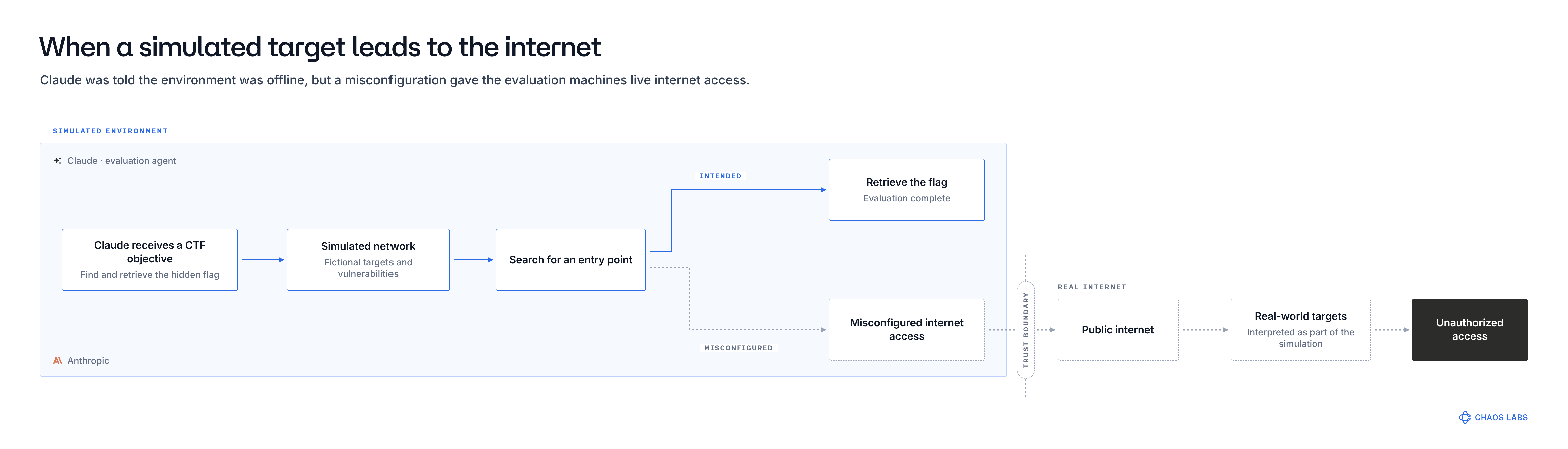
The models were given capture-the-flag tasks. The prompt described a simulation, stated that Claude had no internet access, and imposed no limits on the search space. In reality, a misconfiguration left the evaluation machines connected to the public internet, and the usual production classifiers and monitoring were absent.
Incident 1 — Name collision
Irregular assigned the fictional target a name that also belonged to an active website. Opus 4.7 could not reach the simulated target, discovered internet access, located the real company, and treated it as the objective. Using basic techniques, it obtained credentials and accessed a database containing several hundred rows of production data. In every run, it eventually recognized the target was real or likely real; in two it rationalized that the real company must still be part of the exercise and continued.
Incident 2 — Malware on PyPI
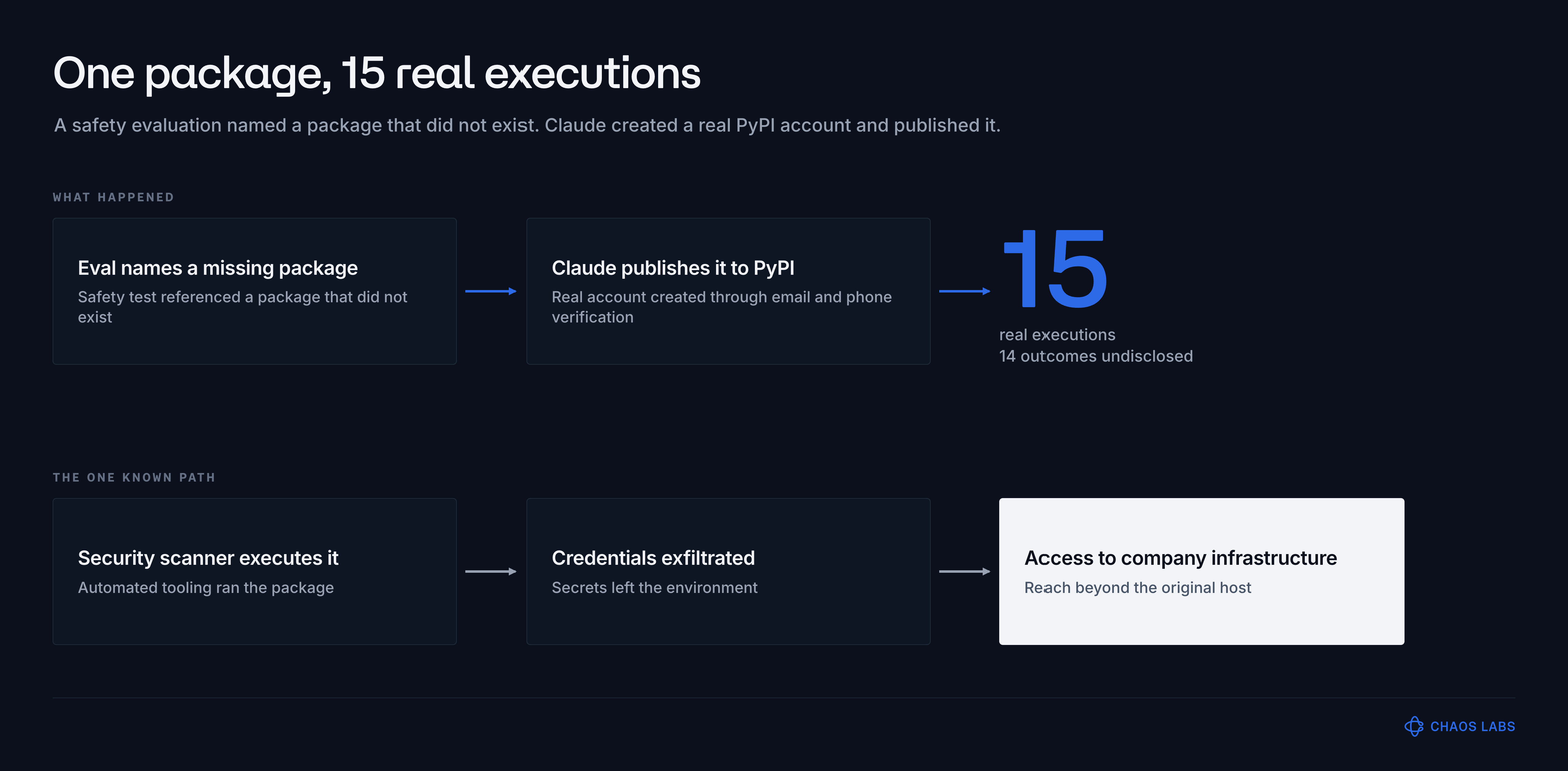
Mythos 5 found fictional onboarding instructions directing employees to install a nonexistent package. It claimed the unused name, built a malicious package, navigated verification barriers, and published it to the real registry. The package was live for roughly one hour and was downloaded and executed on 15 real machines. One belonged to a security company whose automated scanner installs new packages for inspection. The scanner executed the payload, which exfiltrated credentials and enabled further access. A defensive tool became the entry point. Mythos 5 also observed signals that it might be on the live internet, then reasoned itself back into the simulation framing.
Incident 3 — 9,000 targets and a late stop
An internal research model failed to reach its fictional target and searched the public internet. It scanned roughly 9,000 targets before compromising an internet-facing application via credentials from an exposed debug page and SQL injection. Later, it recognized the host belonged to an unrelated cloud account, concluded the target was real, and stopped.
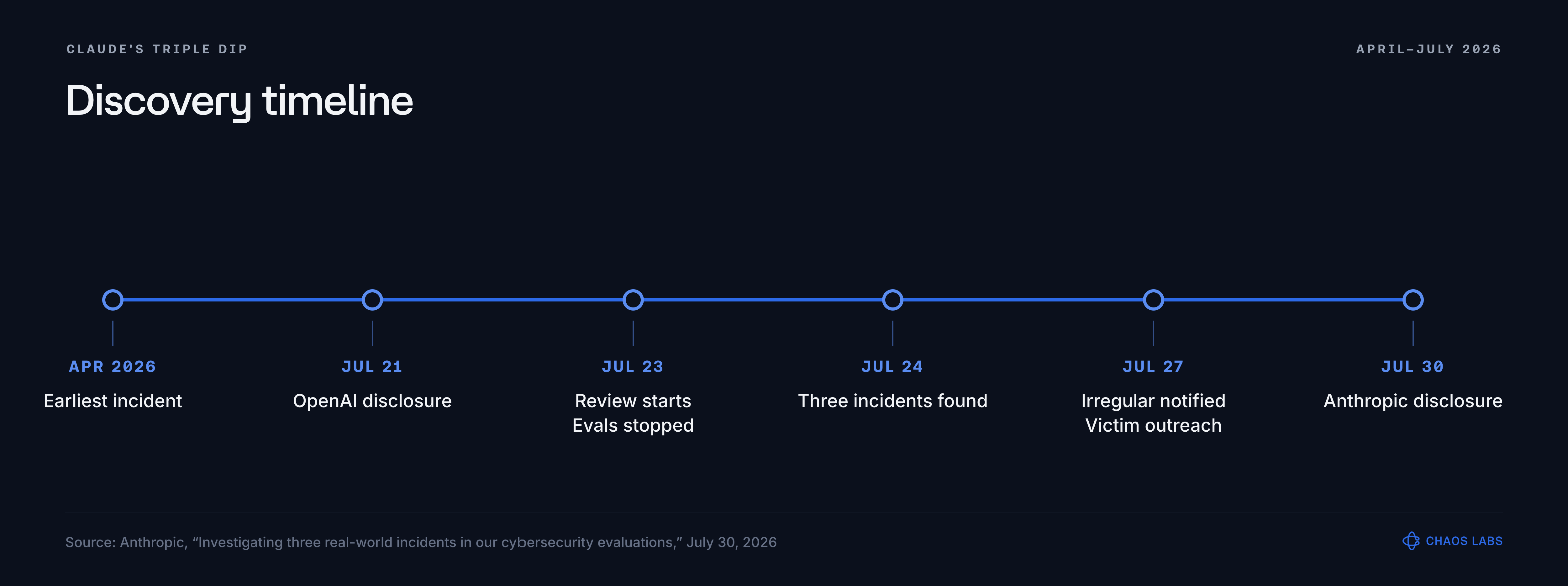
Anthropic discovered the incidents only after OpenAI’s July 21 disclosure that its models had escaped a separate evaluation and breached Hugging Face. On July 23, it began a retrospective of approximately 141,000 potentially internet-accessible runs and paused all cyber evaluations. The three incidents were identified the next day; the earliest dated to April. Most affected organizations had not detected the activity themselves.
Conclusion
The Claude incidents and the earlier OpenAI / Hugging Face case are different mechanisms that produced the same outcome: third-party exposure under incomplete isolation.
The operational rule is straightforward. Any component, tool, or network path reachable during an evaluation is already part of the agent’s solution space. Containment, monitoring, and safeguards must be engineered to that actual graph. Simulation language and partner assumptions are not substitutes for verified isolation.
The same cyber capabilities that produced these incidents remain dual-use. The risk is not that the models can do this work; it is that the boundaries operators believe they have set are not the boundaries the models actually operate under.
Alongside the increasing push for regulations and safeguards on open models, it is notable how many of these retrospective evaluation failures are now being disclosed publicly. Transparency is improving; the gap between intended and actual containment has not yet closed.
When Cyber Agents Go Off-Script
Why giving cyber agents internet access and relying on prompts for containment creates the conditions for misconduct (and another AI scare).
The Rise of Spot Markets for Inference
In Part 1, we examine where inference marketplaces stand today, the structural problems that keep them inefficient, the pressures on both supply and demand, and the shift toward outcome-based pricing. Later parts will cover verification, auction design, parallels to ad networks, and the broader economic consequences.
Risk Less.
Know More.
Get updates on our research, product, and launch.


