


The New Source of Edge in Financial AI
AI has reached global scale, with leading models approaching one billion weekly users and baseline reasoning capability widely accessible.
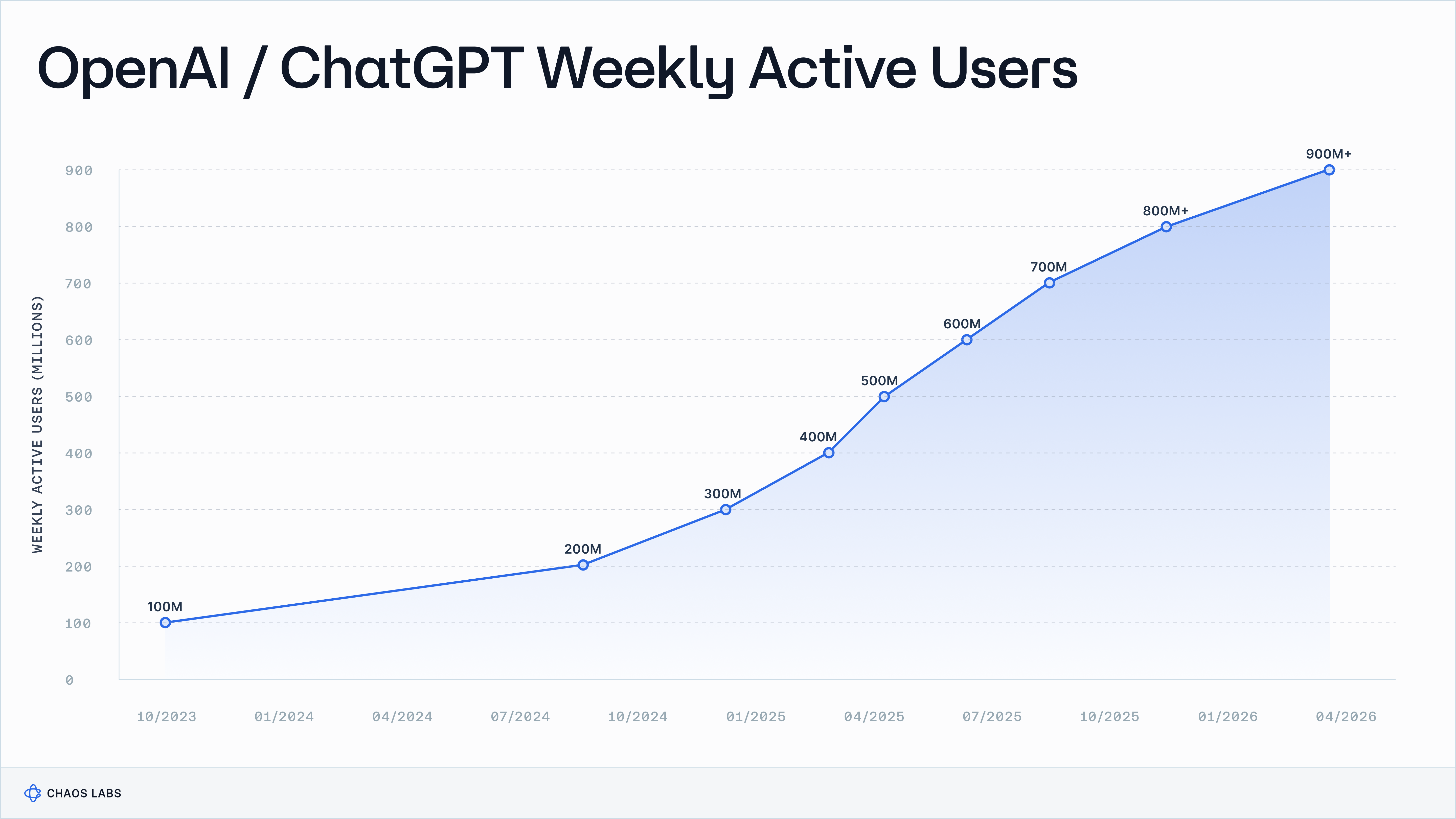
Early advantage came from access, then from model quality, both of which have now compressed and shifted where edge can be created.
In finance, where outcomes depend on precision, timing, and execution, generic intelligence does not sustain an edge. As reasoning converges and access expands, competition shifts toward the application of intelligence.
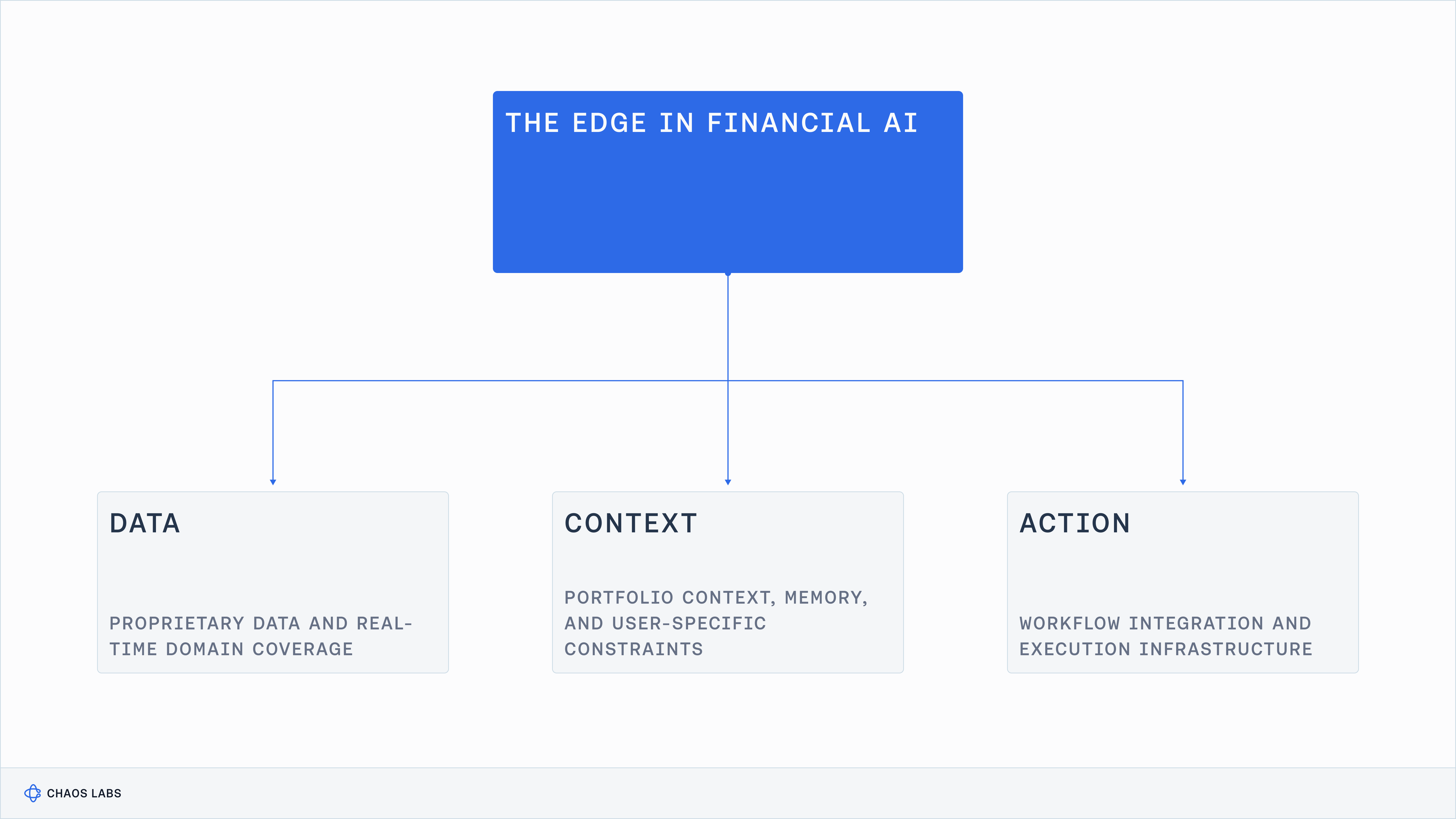
This new reality resets the financial AI landscape across three dimensions:
- Data: Access to proprietary, real-time, and domain-specific inputs beyond publicly available sources
- Context: Awareness of portfolio state, constraints, and previous decisions/constraints
- Execution: Integration with pre-existing workflows and infra, leading to better reasoning and validated actions
The Redistribution of Edge
Model convergence has raised the floor for AI usage.
An average non-technical investor or analyst can produce high-quality research, monitoring, and portfolio construction at a fraction of the cost and time, turning what was once differentiated work into baseline capability.
As more participants rely on similar models to process the same public information, generic edge compresses. Analysis remains useful, but its ability to differentiate declines.
The half-life of insight shortens. Once a narrative, opportunity, or risk becomes legible to a strong reasoning engine, multiple participants can arrive at similar conclusions in a short time frame, reducing the durability of that insight.
This dynamic is amplified in finance, where outcomes depend on execution, timing, and constraints. As intelligence becomes broadly accessible, differentiation concentrates around proprietary data, persistent context, and execution infrastructure.
In summary: model convergence lowers the cost of intelligence and shifts advantage to how it is applied.
Proprietary Data and Domain Coverage
Data is the first source of edge.
In financial AI, output quality is determined by relevance, timeliness, structure, and access to proprietary inputs, while generic models rely on indexed data such as webpages, filings, news, and docs. A significant share of actionable financial information exists outside this layer, sourced directly from APIs, blockchain networks, exchange feeds, smart contracts, and internal datasets.
Knowing that sentiment is bearish on an asset differs from validating that view through funding rates, borrow dynamics, positioning, and market structure.
Similarly, knowing that a vault offers a given yield differs from understanding the underlying strategies, borrower incentives, liquidity concentration, and embedded dependencies.
These limitations were evident in the Nof1 Arena Competition, where models operated without access to structured, real-time data.
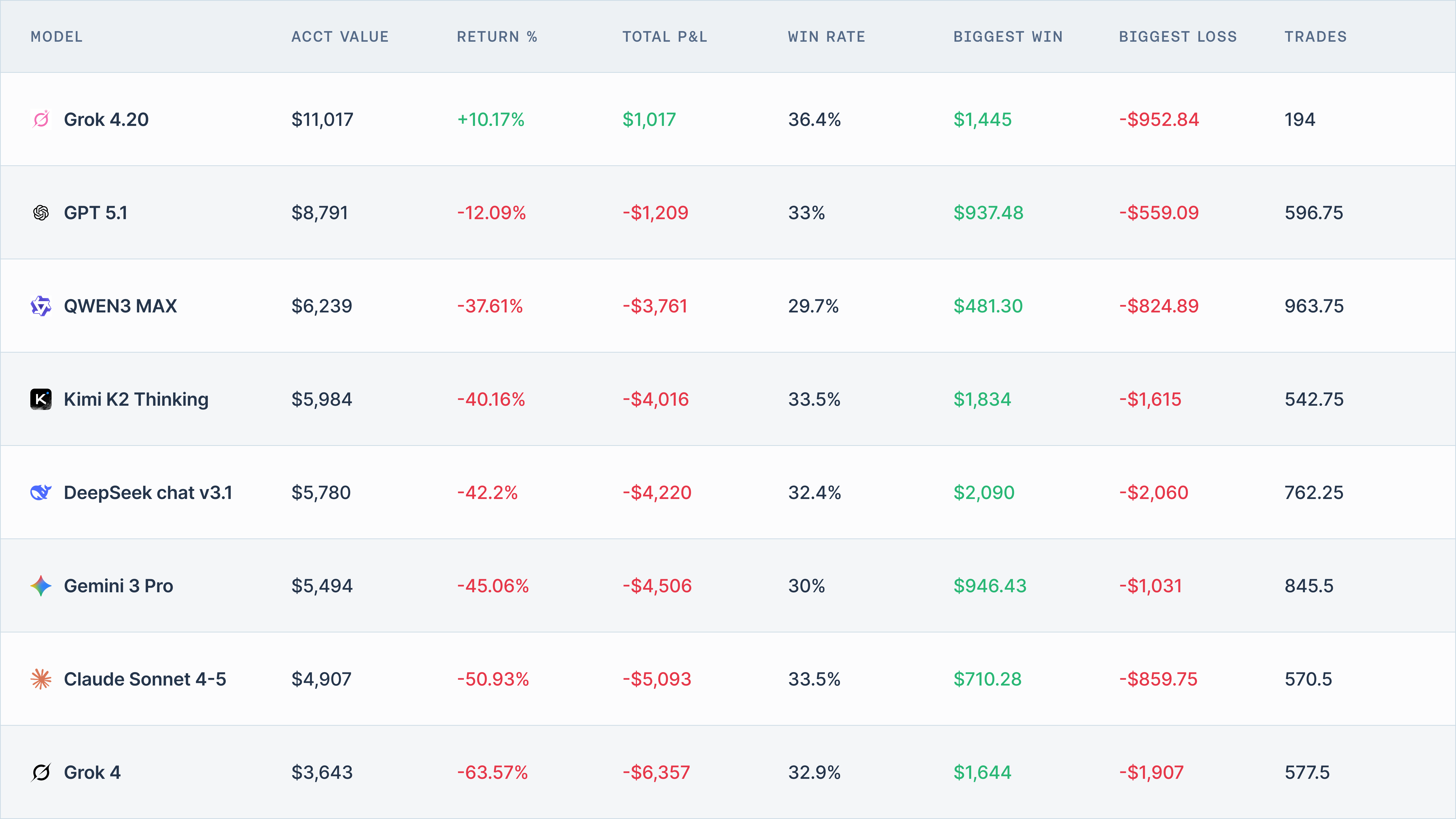
Finance is highly sensitive to staleness and precision. Outputs that appear coherent lose value when disconnected from underlying mechanics.
Edge shifts toward participants with deeper data coverage and stronger data pipelines.
Portfolio Context, Memory, and User-Specified Constraints
Context is a second source of differentiation in financial AI.
Finance operates in a stateful environment where positions evolve, market assumptions shift, and risk management changes over time; therefore, outputs need to remain anchored to current portfolio conditions and prior decisions rather than being treated as isolated responses.
In addition, referencing prior conversations alone does not provide sufficient continuity.
Context must persist across interactions, maintaining continuous awareness of portfolio constraints and user-specific requirements so that each output reflects the actual operating environment.
Without this continuity, model outputs can remain technically correct but operationally unusable.
Workflow Integration and Execution Infrastructure
The third source of differentiation is operational depth, which determines how effectively reasoning translates into outcomes.
Identifying an opportunity is one step; translating it into action requires validating constraints, checking execution conditions, and then executing. Financial AI utility increases when integrated with an operating environment with workflows that can validate conditions and prepare actions to operate closer to execution
This shift concentrates advantage across three areas:
- Validation: Checking constraints, liquidity, and execution conditions before action
- Preparation: Translating outputs into structured, executable steps
- Execution: Operating within defined constraints while monitoring outcomes in real time
Edge shifts toward systems with deeper workflow integration and execution infrastructure, where the differentiator is the ability to convert reasoning into action.
Depth: The New Moat
As frontier models converge, intelligence becomes more abundant and less defensible in isolation, changing the structure of advantage in financial AI.
This durable edge shifts from the model to the depth of what is built around it.
Depth and edge reflect an accumulation of layers, including data coverage, context retention, workflow integration, execution capability, and continuous reinforcement.
Proprietary data and context improve reasoning
Persistent context improves relevance
Workflow integration enables action.
As access to intelligence converges, differentiation lies in the depth of context surrounding it.
The Stateless Institution: The Architecture of Forgetting
In this piece, we argue that most AI memory architectures still operate as retrieval systems, surfacing relevant information at inference time without preserving the reasoning that produced prior conclusions. As AI adoption scales across institutional workflows, the distinction between retrieving context and accumulating validated organizational state becomes increasingly important, determining whether analytical work compounds over time or is continuously recomputed from scratch.
WLFI: Collateral Loop Breakdown
Recent activity on Dolomite shows a sharp increase in borrowing tied to World Liberty Finance. Over the past few days, this team, which already held open positions on the protocol, expanded its exposure materially, pushing WLFI collateral utilization close to its limit and driving a steep change in stablecoin borrowing.
Risk Less.
Know More.
Get updates on our research, product, and launch.


