


The Authority Gap: The Distance Between Output & Action
A year ago, most discussions around enterprise AI focused on model capabilities.
Are models reliable enough to write production-level code? Can they produce research sophisticated enough to influence decisions? Can they automate meaningful portions of operational workflows?
Model capability was the primary constraint at the time, and most large enterprises were evaluating whether fully autonomous AI agents were ready to participate in core product and business functions.
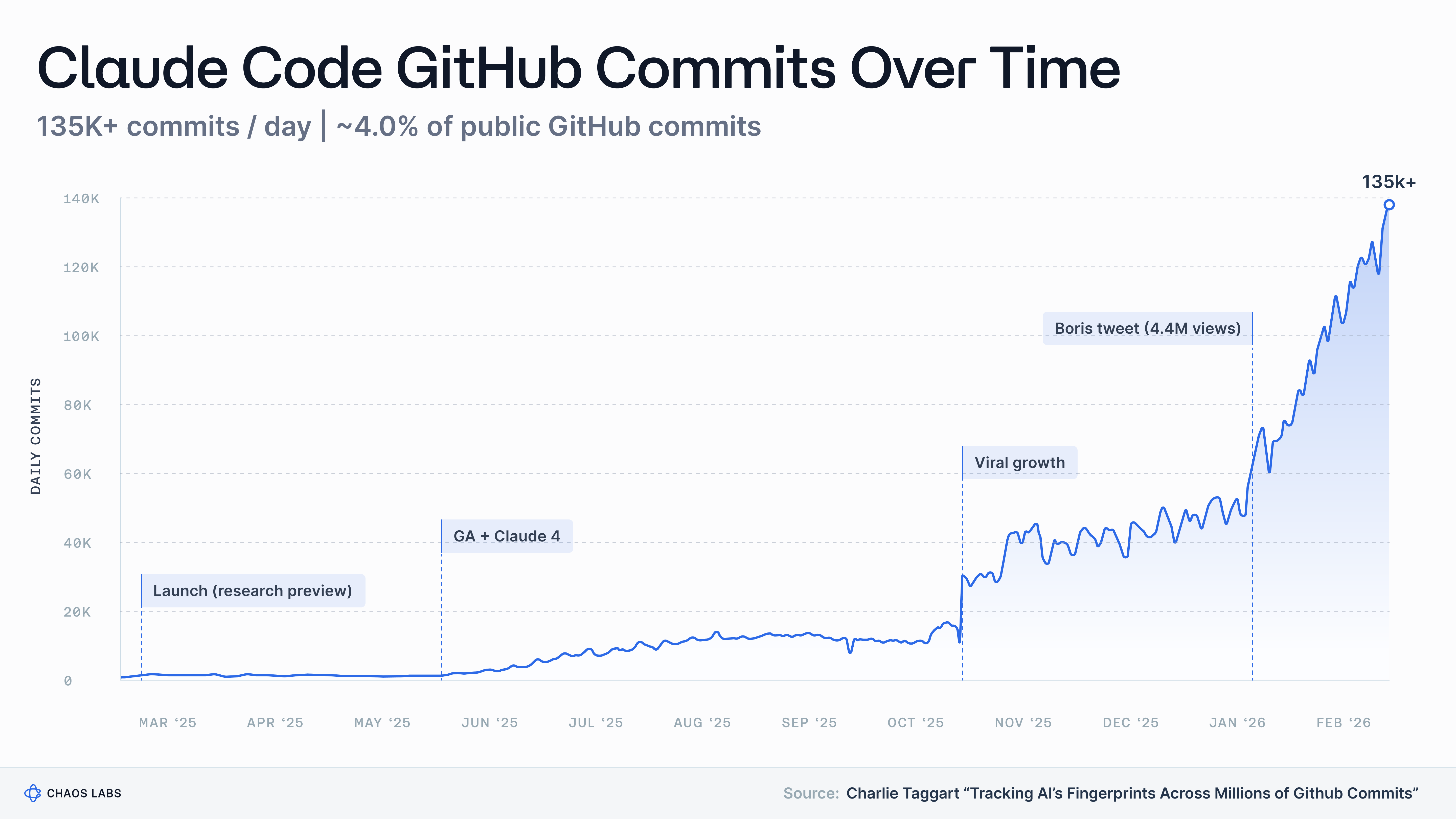
In the short span of a few months, the advances in frontier models, agentic workflows, and memory have surpassed these benchmarks and AI is increasingly embedded across software development, research, operations, customer support, and a growing range of knowledge work. The capabilities of these models have advanced so fast that OpenAI researcher Noam Brown noted that we will soon struggle to measure the frontier of these models, given the cost-prohibitive nature of these tests.
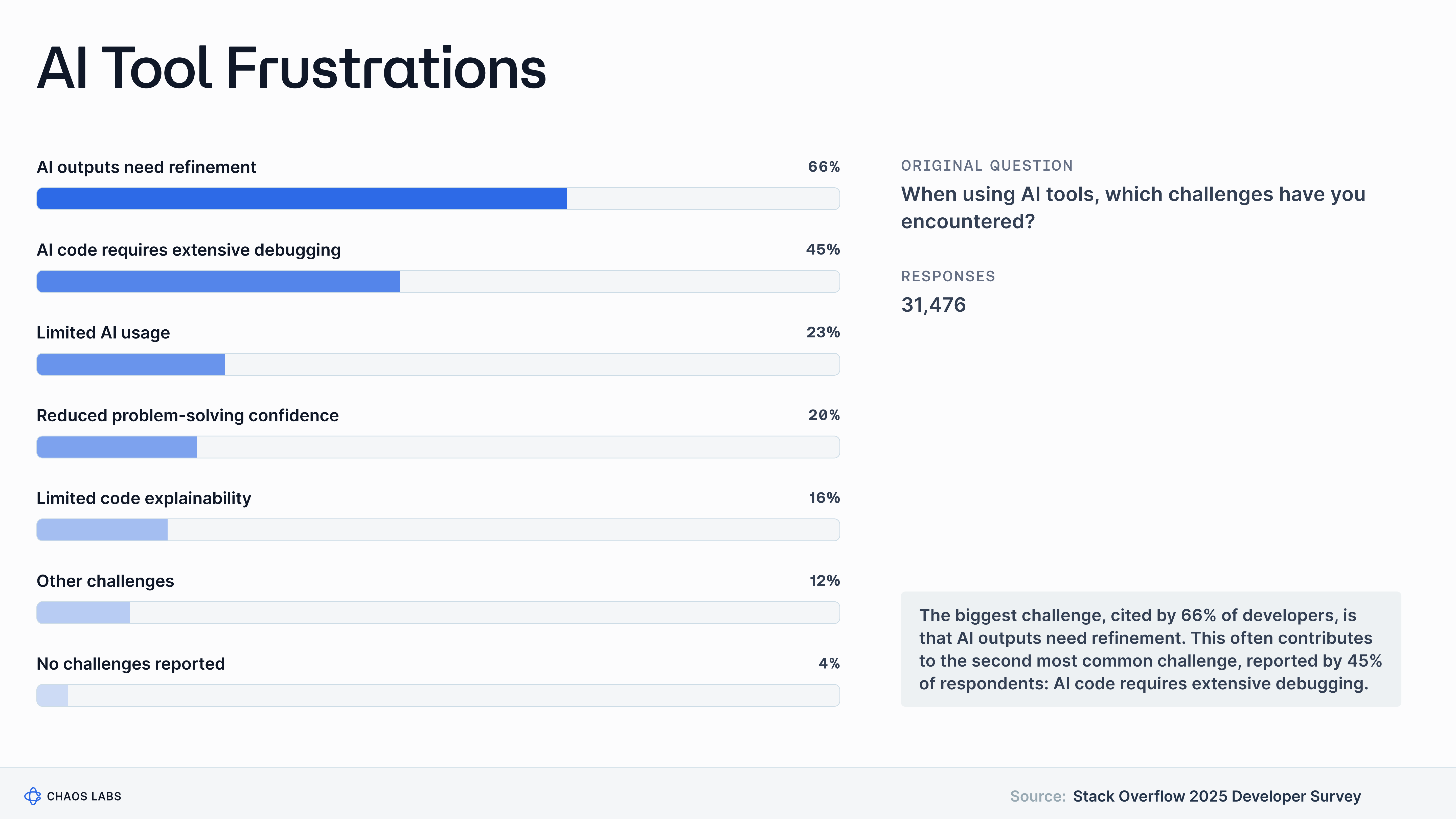
In parallel, a common frustration reported by developers in Stack Overflow’s Developer Survey was dealing with AI solutions that were “almost right, but not quite.”
It’s clear that model capability and organizational confidence in AI are separate topics.
Large enterprises, by nature, operate under unique constraints where a minor error or overlooked dependency could have consequences that extend far beyond the original task. As a result, generating an output is often the easiest part of the workflow; establishing sufficient confidence to act on this output is considerably harder.
The Authority Gap is the imbalance between the rate at which AI outputs are produced vs. the rate at which organizations build enough confidence to incorporate AI-assisted outputs into their operational processes.
Auditability: A Pre-Requisite for Verification
Organizations deploying LLMs in production quickly discover that outputs require review.
A key challenge is that an AI response or solution often reveals very little about the process that produced it. An output does not necessarily imply a reliable workflow; the same result may be achieved through different sources, assumptions, tools, permissions, and intermediate steps, each carrying a different level of risk.
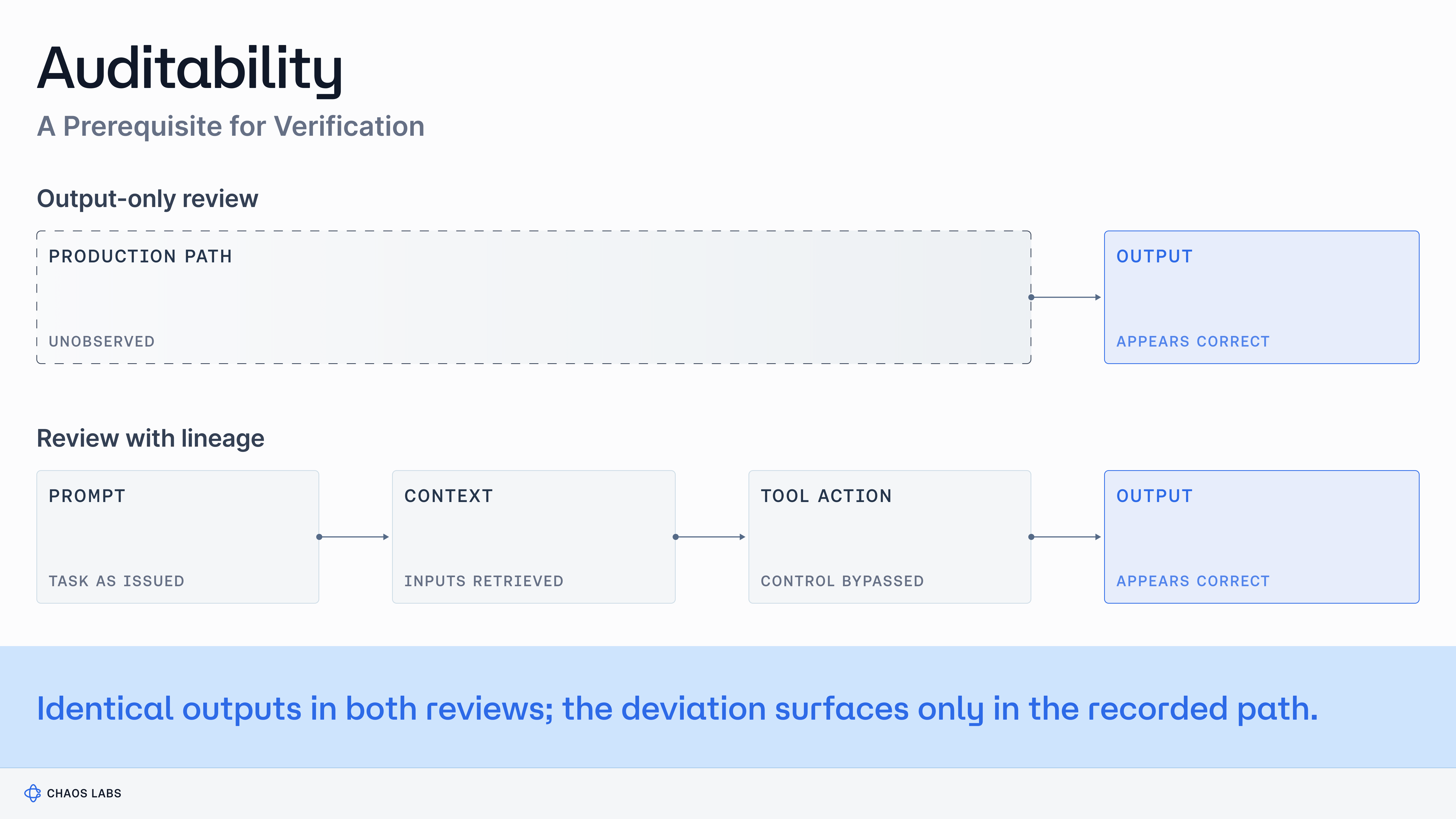
Organizations, therefore, require visibility into the production path behind an output. Sources, assumptions, tools, permissions, intermediate steps, and validation checks become part of the evidence required to evaluate whether a workflow can be trusted and reused. Without this lineage, every output becomes a standalone validation exercise.
Scaling Verification: an Enterprise Authority Layer
AI produces work far faster than most organizations can review, creating a second-order problem where every increase in production capacity expands the volume of work requiring validation before it can be trusted.
At the same time, reviewers are expected to apply evidence standards, approval requirements, escalation criteria, permissions, and operational controls consistently across an expanding set of workflows. What begins as a review problem gradually becomes an infrastructure problem.
Security controls, deployment pipelines, risk limits, and compliance frameworks emerged because institutional reliability could not depend entirely on human memory and manual enforcement; AI workflows are converging toward the same requirement and at enterprise scale, the problem is broader than any single agent or implementation.
This creates the need for a layer that sits above individual model calls and agent sessions. Its role is to give the organization visibility into how AI is being used across the enterprise: which workflows are running, what sources and tools were involved, what evidence supported the output, which checks were performed, where human approval is required, and ultimately, if the generated response is acceptable.
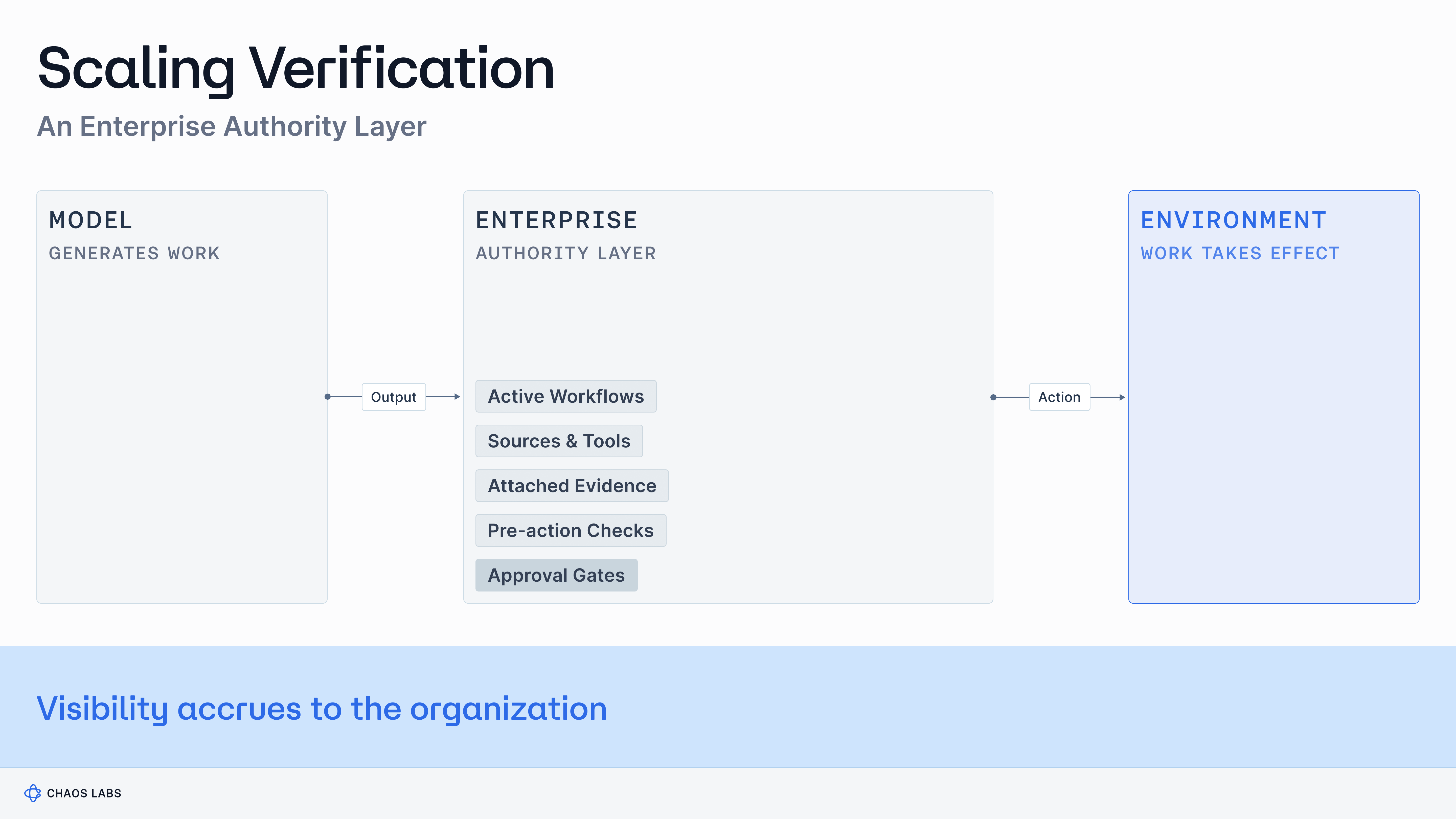
Rather than treating verification as a series of disconnected review decisions, this layer turns AI activity into an observable and auditable process. It also allows the organization to evaluate the generated work against a documented chain of actions rather than just the final output. This is especially important because organizations increasingly use AI across multiple surfaces simultaneously: chat interfaces, coding agents, internal assistants, research workflows, support tools, APIs, and domain-specific systems.
AI adoption will not happen within a single, uniform workflow.
At Chaos Labs, we experienced this firsthand while building Chaos AI. Different workflows require different evidence standards, permission boundaries, validation paths, and approval requirements. An enterprise authority layer provides a way to express those differences across workflows while maintaining a common structure for visibility, auditability, and review.
In this sense, the authority layer is the operating layer that connects AI activity to evidence, permissions, validation paths, ownership, and accepted work.
Its purpose is to make reviews more structured, consistent, and scalable, enabling organizations to keep pace with the volume of work generated by AI workflows.
Ownership in an Agentic World
As AI systems become more intelligent and deeply integrated into business workflows, the role of human operators will evolve.
Humans may no longer perform every step or review every intermediate decision. However, this shift doesn’t mean that ownership disappears; if anything, it becomes more important. In simpler AI workflows, a human is often both the prompter and the reviewer, and as a result, ownership is relatively straightforward: the individual owns the work output.
In agentic and enterprise workflows, the situation becomes more complex, with the human role increasingly shifting toward defining authority boundaries around the work. Agentic workflows may retrieve context, call tools, inspect repositories, modify files, open tickets, update records, or recommend actions before a human effectively sees the outcome.
In this case, its no longer about an individual prompt or model response, but about a broader “work unit,” which includes the customer reply, code change, compliance check, research brief, or internal decision.
To highlight the challenges this poses, we can start from the outermost layer: accountability.
Accountability does not disappear simply because more of the work is delegated to an AI workflow. In the 2024 Air Canada case, courts ruled that although the customer interaction was generated by an AI system, responsibility for the outcome still belonged to the company. This creates a practical requirement for agentic systems.
If individuals or organizations remain responsible for the outcomes produced by AI-driven workflows, they must also have meaningful ways to govern and control these workflows. Otherwise, they risk being held accountable for decisions and actions they deliberately placed beyond their ability to supervise.
Conclusion
The Authority Gap is the gap between just producing an AI output and integrating it as part of the organizational work.
As models become increasingly more capable, the limiting factor for enterprise AI adoption becomes whether generated work can move through a structured process that allows an organization to verify, govern, and ultimately own the outcome.
Ownership requires verification, which requires auditability.
The infrastructure surrounding the model therefore becomes increasingly important. Audit trails, source lineage, validation checks, permissions, approval gates, escalation paths, and ownership rules determine which outputs can be trusted and incorporated into institutional knowledge.
Organizations that capture the full value of AI are those capable of turning generated outputs into verified, governed, and accountable work. Enterprise AI adoption will ultimately depend on whether organizations can build the authority layer needed to enable this transition.
From Tokenmaxxing to Token Yield
Some AI workflows compound into durable organizational leverage. Others consume enormous amounts of inference without creating much value at all, and from the invoice alone, they often look remarkably similar.
The Stateless Institution: The Architecture of Forgetting
In this piece, we argue that most AI memory architectures still operate as retrieval systems, surfacing relevant information at inference time without preserving the reasoning that produced prior conclusions. As AI adoption scales across institutional workflows, the distinction between retrieving context and accumulating validated organizational state becomes increasingly important, determining whether analytical work compounds over time or is continuously recomputed from scratch.
Risk Less.
Know More.
Get updates on our research, product, and launch.


