


The Stateless Institution: The Architecture of Forgetting
LLMs are stateless by design.
Microsoft reportedly canceled Claude Code licenses after token-based billing became difficult to sustain at scale. Uber's CTO warned internally that the company had burned through its projected 2026 AI budget in just 4 months. SemiAnalysis pulled data from 432k coding-agent requests and found the median request consumes ~96k input tokens, with roughly half exceeding 128k.
These incidents all share a common cause.
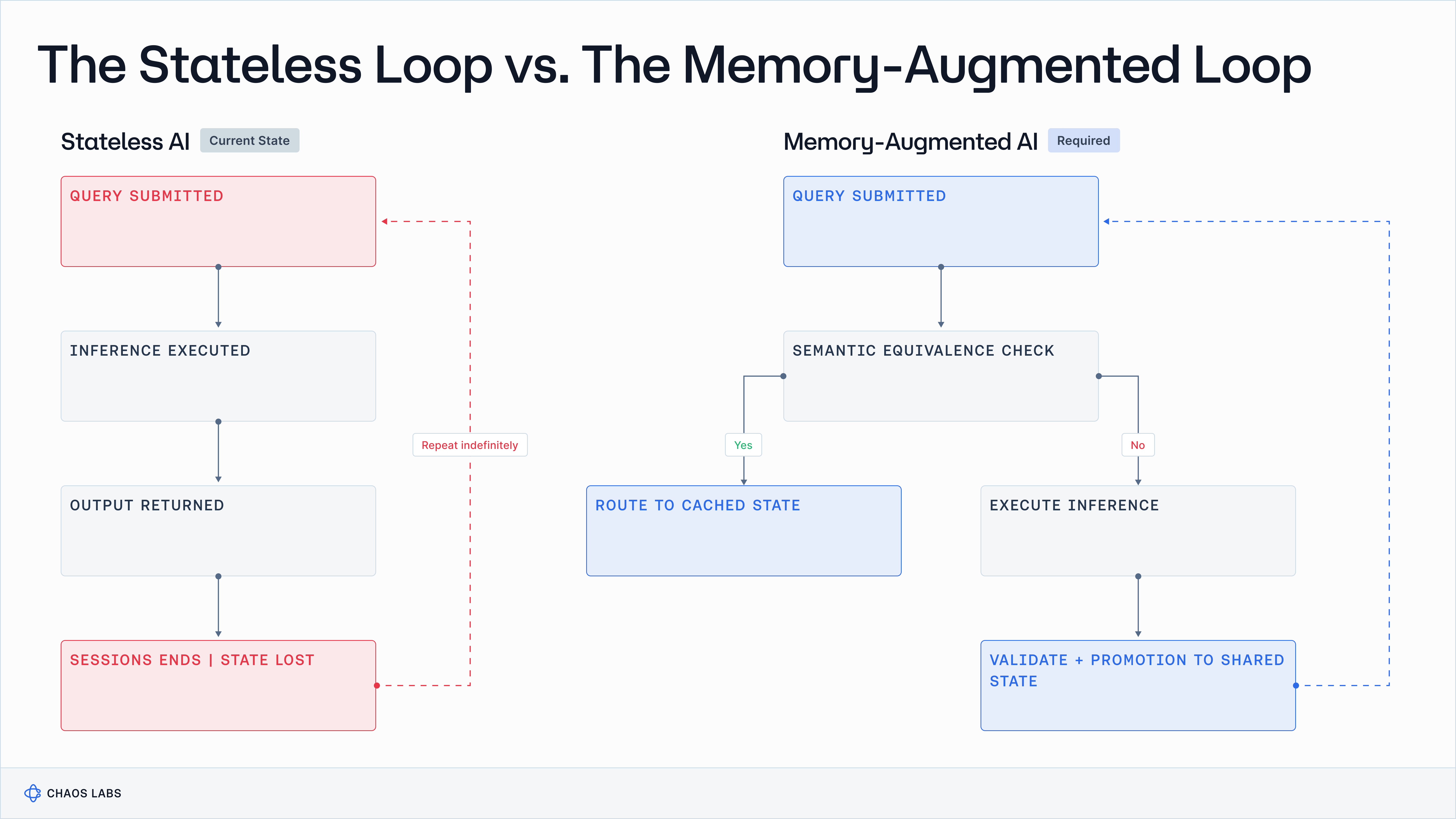
Models have limited memory of prior reasoning, almost no awareness of adjacent analytical work across an organization, and no immediate mechanism for recognizing that the question being asked now may overlap with reasoning already performed within the institution. This design creates fault isolation and predictable inference boundaries because each session executes independently rather than shared across the organization.
At enterprise scale, statelessness becomes a tax paid in tokens, time, and analytical inconsistency. The shape of that tax is easiest to see inside a single firm.
In effect, statelessness is a design choice with tradeoffs.
Inside a Tier 1 Financial Institution at Scale
Take the case of a financial institution running AI workflows across research, legal, operations, compliance, and customer support. The limitations of statelessness compound in two core areas.
First, in repeated inference.
For large orgs like these, AI-assisted research repeatedly converges on overlapping analytical tasks, even when framed by different prompts, workflows, and operational contexts.
A financial services firm continuously reassesses:
- market structure analysis and counterparty exposure
- regulatory interpretation
- macroeconomic conditions
- diligence frameworks
Each of these tasks gets re-reasoned from scratch every time the workflow recurs. Inefficiency compounds as workflows shift toward agentic execution: a single agentic task can consume 1,000 times as many tokens as a standard chat interaction. A similar task exhibits 30x cost variance without producing better outputs. Higher token spend often degrades accuracy rather than improving it (Bai et al., 2026, SemiAnalysis N=432K agentic-coding requests).
A second problem is that stateless architectures do not allow institutional reasoning to accumulate over time.
Human organizations compound knowledge both horizontally and vertically:
- A team of analysts build on each other’s work
- Assumptions are inherited from prior conclusions
- Precedents emerge through repeated reasoning, revision, and challenge across workflows
This continuity improves both efficiency and output quality over time because prior analytical work remains accessible to future decision-making processes.
Stateless AI systems do not preserve this continuity. Every session begins from the same blank state, with no durable linkage to prior reasoning, validation paths, or organizational conclusions. The intelligence generated by the organization, therefore, does not accumulate across workflows and is lost at the end of each inference cycle.
The Toolbox for Institutional Memory
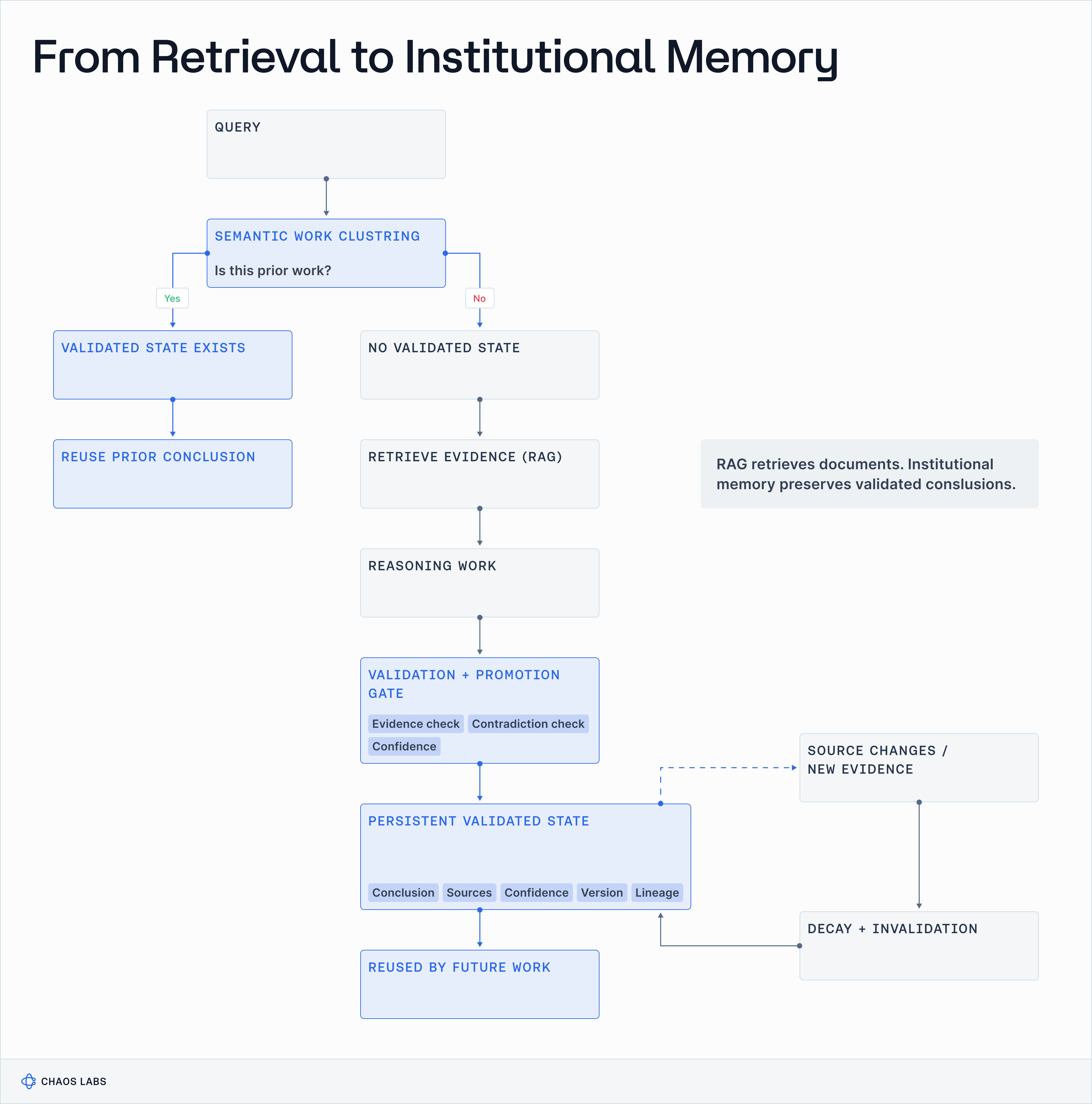
RAG systems improve document retrieval during inference, but retrieval alone does not preserve organizational reasoning. Documents surfaced through RAG are not reasoning: retrieving a prior report does not tell the model what conclusion was reached, what assumptions were made, or how much confidence the organization places in that output. While RAG reduces redundant retrieval, it does not eliminate redundant reasoning.
This distinction becomes increasingly important in institutional environments where workflows depend on the continuity between prior analytical decisions, the current operational context, and future downstream actions.
Institutional memory, therefore, requires additional infrastructural layers capable of preserving, routing, reconciling, and updating organizational reasoning over time.
- Semantic Work Clustering is the ability to recognize when two differently worded requests are really asking for the same underlying work. Equivalent workflows should remain linkable across sessions, departments, and operational contexts even when prompts differ at the surface level.
- Work Lineage keeps current outputs linked to upstream assumptions, referenced conclusions, supporting evidence, and inherited reasoning paths. Lineage allows organizations to reevaluate conclusions when conditions change, audit downstream decisions, and identify how updated information propagates through existing dependencies.
These two primitives define the recognition and traceability layer. Other primitives, including validation and promotion, persistent validated state, and decay and invalidation, govern what happens to reasoning once it's been produced. This infrastructure is the subject of the next piece in this series.
The Institutional Analogue
Large organizations already operate through persistent analytical memory structures. Financial institutions, legal organizations, and operational teams continuously maintain and revise institutional positions across markets, counterparties, regulatory interpretations, operational procedures, and risk frameworks. These positions persist beyond the individuals or workflows that originally produced them because they remain embedded inside broader organizational decision-making systems.
Bloomberg won the financial workflow by sitting inside the moment where information, analytical interpretation, operational execution, and decision lineage interact. Institutional AI memory occupies the same shape of position, one layer up. As baseline model capabilities become increasingly accessible, differentiation shifts toward the infrastructure that governs how analytical work persists across workflows, connects across teams, updates under changing conditions, and remains traceable over time. This also changes the economics of inference.
The Cost of Statelessness
Stateless systems were built around isolated execution, while institutional reasoning depends on continuity across workflows over time. This architectural gap is where the cost is showing up for enterprises, and is also where the infrastructure response begins.
The next piece in this series gets into why no single model vendor will solve the continuity problem and why the answer has to be cross-provider by design.
The Authority Gap: The Distance Between Output & Action
Producing an answer and accepting an answer are increasingly separate activities. As AI systems become embedded across software development, research, operations, and customer support, organizations face a new challenge: building enough confidence in AI-generated work to act on it.
The New Source of Edge in Financial AI
In finance, where outcomes depend on precision, timing, and execution, generic intelligence does not sustain an edge. As reasoning converges and access expands, competition shifts toward the application of intelligence.
Risk Less.
Know More.
Get updates on our research, product, and launch.


