


Five Levels of Agentic Finance
Table of Contents
The term "agentic finance" is being applied to a lot of things.
- A chatbot that surfaces market data on request
- A model that automates or drafts portfolio commentary
- A copilot that answers questions about market positions
While we can all attest that these tools have been extremely useful in both our personal and professional lives, we all need to agree that calling them agentic overstates what they actually do. We believe this matters because labelling affects progression. Finance has more data than it can process.
This has been true for decades and the information overload will increase exponentially in the coming months. The constraint is the loop:
observation → interpretation → decision → action.
Most financial AI products today close one or two links in this chain; almost none close all of them. Here's a framework for understanding where a product sits in that progression, and what it can and cannot do as a result.
What Is Agentic Finance?
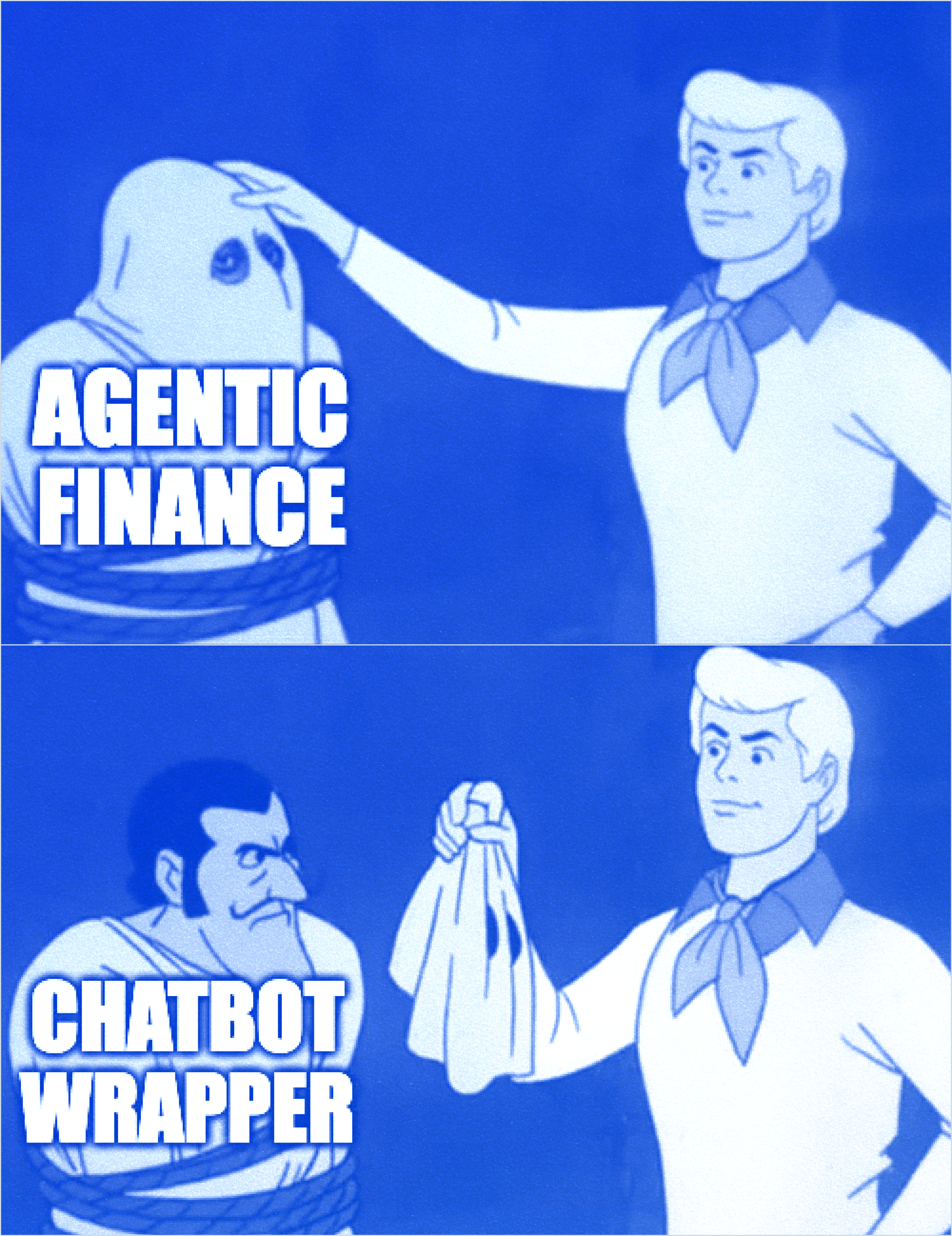
The term "agentic finance" in most cases is typically a conversational layer or app built on top of financial data: a chatbot that can answer questions or generate market commentary from online search. Useful, perhaps, to replace or complement a search engine, but not meaningfully agentic.
Agentic finance is much more than querying data or generating plausible analysis and includes the capability to carry the work, i.e., understanding relevant context, reasoning within constraints, retain continuity over time, and take actions within clearly defined boundaries.
This is a much higher standard, and it is where most existing AI products still fall short.
The Five Levels
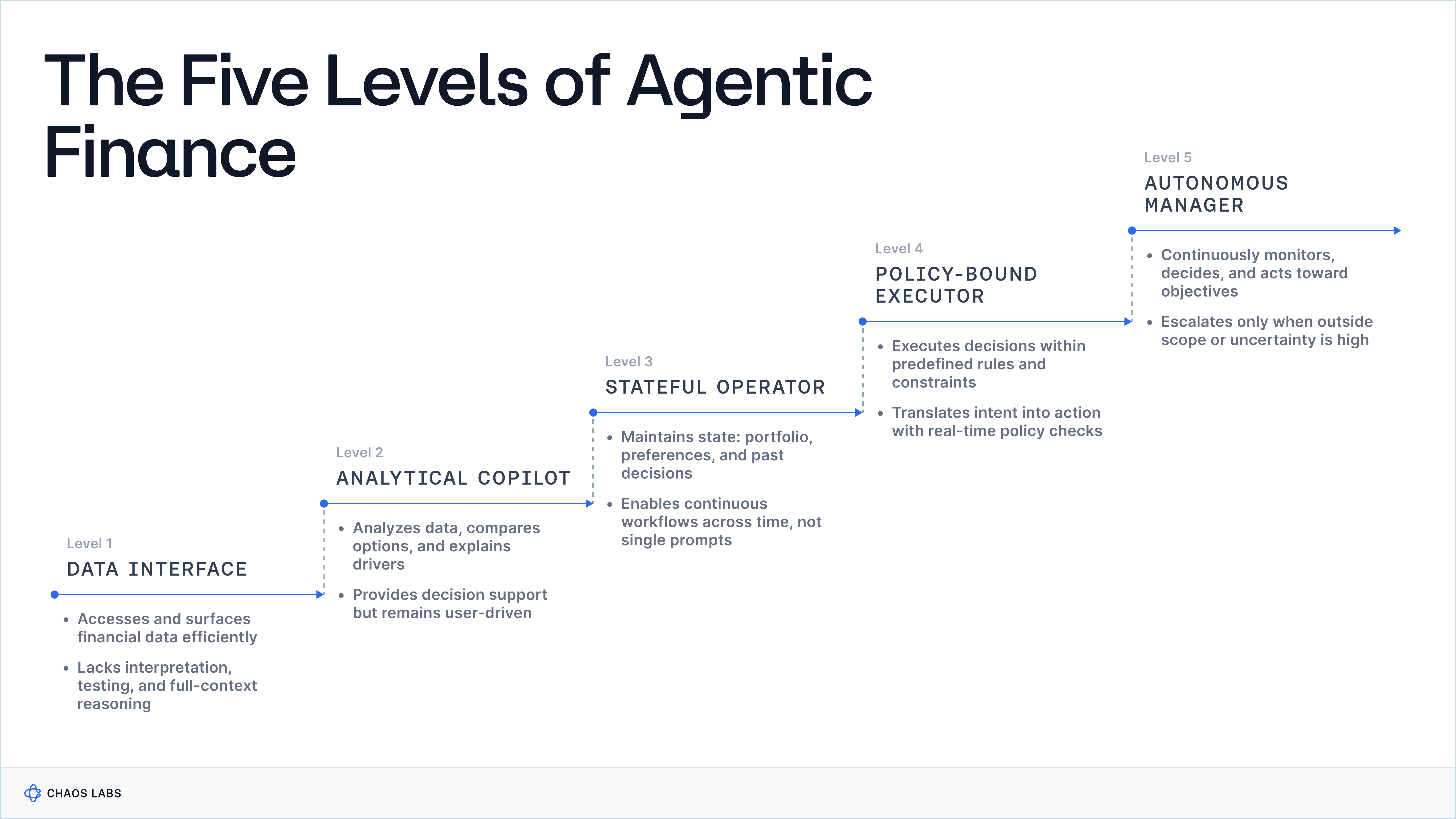
1. Data & Static Intelligence
At this level, AI agents are simple interfaces for accessing financial information.
These agents can process large unstructured datasets, answer factual questions based on this data, summarize positions, and generate reports in natural language. The more specific and real-time the data, the more powerful the agent is at processing this domain-specific data. While these agents are fundamentally "read layers," they do offer a starting point and could provide value, helping the user access information more efficiently. Their drawbacks: these agents can patch together a market thesis but typically fall short at accurately testing or validating their hypotheses. They are also prone to a people-pleasing bias (defaulting to what the user wants to hear, regardless of what the data actually supports) and in most cases use partial context rather than a holistic read.
2. The Analytical Copilot
These agents can analyze markets, explain performance drivers, surface trade-offs, and stress-test scenarios. While these agents are mostly user-driven, they are helpful for research and decision support, helping the user understand what actually matters, what the possible readings of a series of data points are, and what the possible counter-elements are.
This is where most AI finance products sit today.
The gap that remains: limited memory of previous conversations and context or the objective.
3. The Stateful Operator
An agent that changes the workflow.
These agents hold context across time: portfolio state, previous decisions, objectives, open questions, recurring patterns.
Markets are dynamic and evolving, so an analysis is only useful when connected to a broader task and these agents hold that thread. Execution still sits with a human, however, the cognitive overhead of market continuity and context shifts to the system.
4. The Policy-Bound Executor
Here the agent does more than advisory work and becomes operational.
A pre-defined mandate governs the agents including, what assets it can trade, market venues, how much size, risk parameters, liquidity conditions, acceptable slippage, and when to stop and escalate rather than proceed.
Most financial infrastructure today is not built to support this, given the data quality, permissioning architecture, and audit requirements.
5. The Autonomous Manager
A level 5 agent runs a financial workflow continuously, without waiting for instruction.
It monitors, interprets, decides, executes within mandate, verifies outcomes, and escalates only when something falls outside its scope. Human involvement drops to direction, oversight, and the edge cases the agent knows to surface. The infrastructure requirements are significant: real-time data, memory, tightly scoped permissions, robust escalation logic, and full auditability. Model quality is almost secondary.
You can have the best model and fail at level 5 because your data pipeline has an hour-long lag or your permission model was not designed for autonomous execution.
Conclusion
Agentic finance is not a label that should be applied loosely.
Finance is a deep domain, and an agentic system is one that can master it. This requires continuous progression across several fronts: output quality, data sources, skill set, and responsibility handling.
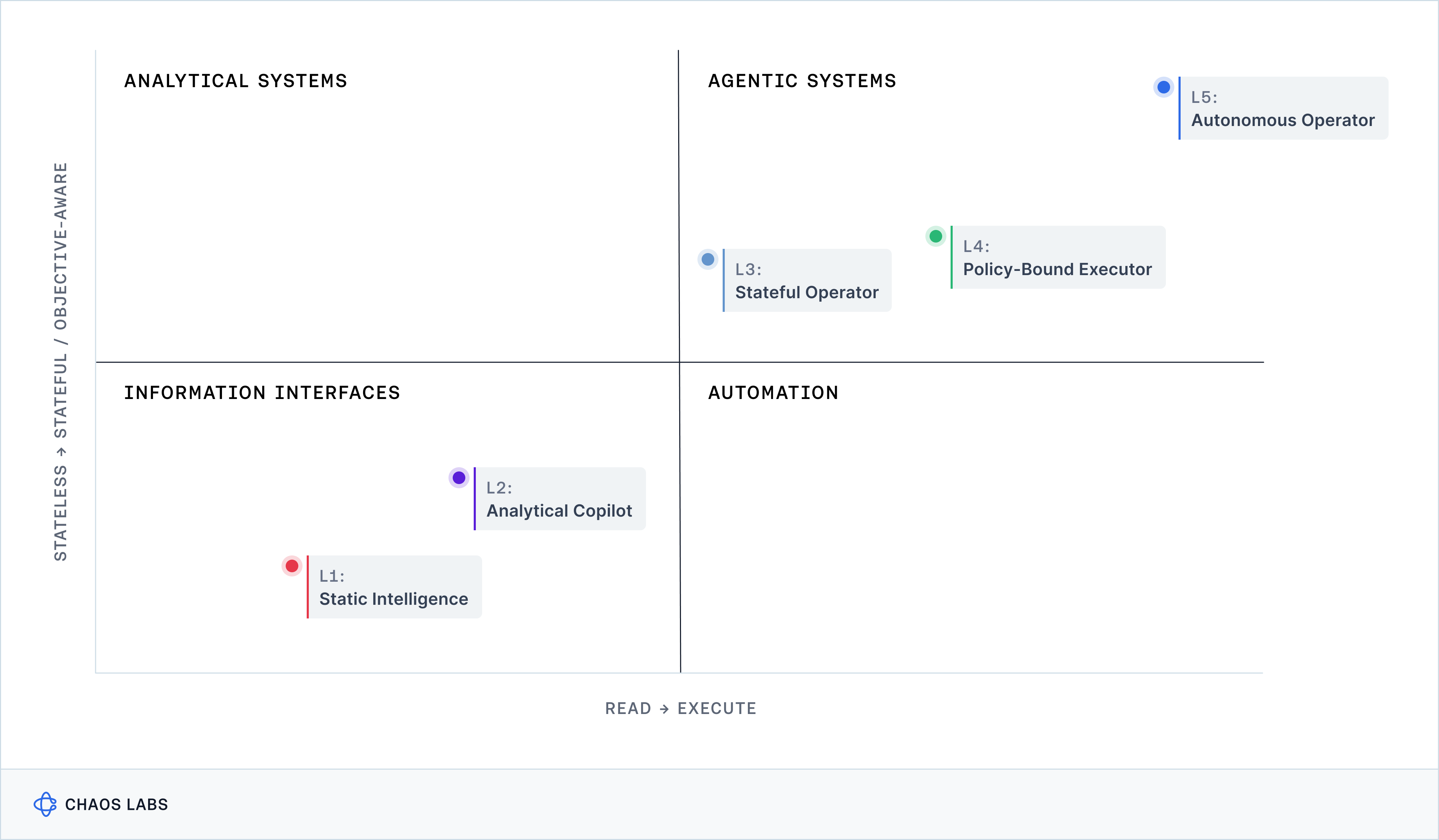
The path runs from visibility, to interpretation, to continuity, to execution within policy, and finally to continuous autonomous operation.
Today, most financial agents sit in the earlier stages. We believe the opportunity lies further up the curve, where financial AI becomes an operating layer that genuinely empowers the end user. At this level, the bar is higher and only teams with a real edge will build financial AI that actually matters.
For further reading on why data infrastructure determines agent capability, see Omer Goldberg's pieces, The Limits of Web Search for Financial AI and Why Web Search Falls Short for Financial Agents.
Drift’s Contagion Loop: From Operational Breach to Market Drain
A breach in control infrastructure, layered dependencies, and capital routing frameworks turned a single exploit into a network event.
DeFi’s Contagion Loop: When Risk Curators Become the Risk
What began as a contained exploit, with only a few thousand dollars at risk, escalated into tens of millions in exposure as capital continued to flow into affected markets under pre-existing allocation logic. The sequence of events that followed was not defined by the initial failure, but by how connected systems responded to it.
Risk Less.
Know More.
Get updates on our research, product, and launch.


